
Listen to this episode


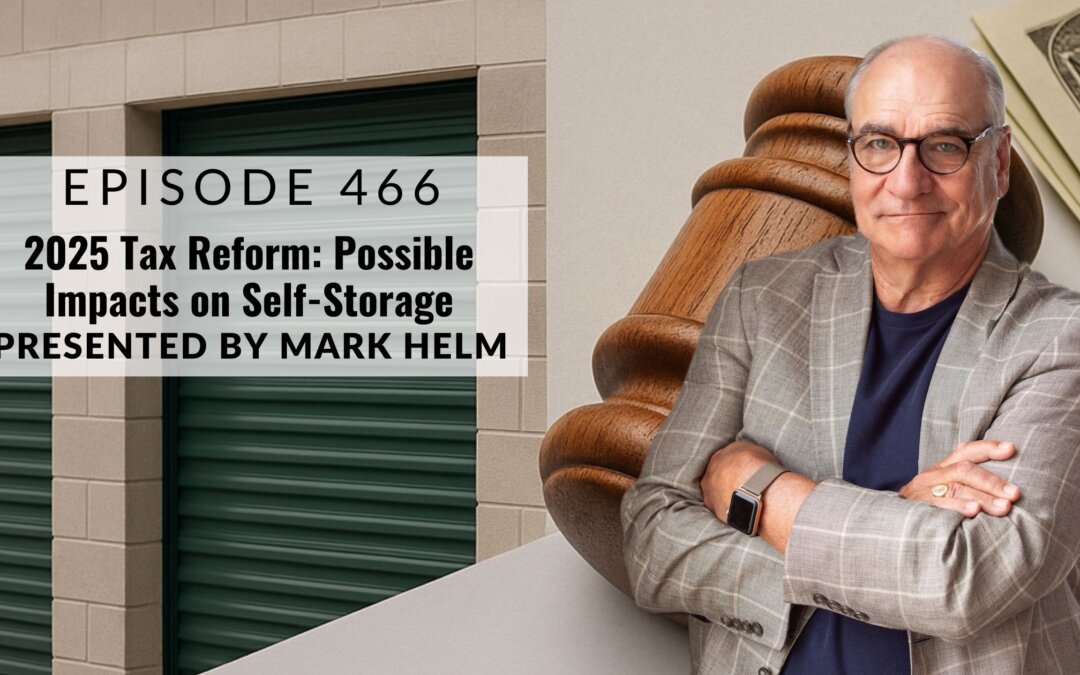
Let’s talk about the new tax implications for self-storage owners and take a look at the good, the bad, and the potentially ugly parts of the massive tax bill recently signed into law and championed by the current administration, at least from my perspective.
Now, full disclosure: I’m not exactly a fan of the guy in the White House. So I was hesitant to even do this episode. But this new legislation includes some changes that are worth talking about, some I like, some I don’t, and a few I think will have long-term consequences for our industry and our economy.
This is a massive bill with broad tax reform ramifications, and while I won’t try to cover it all, I’ll focus on the parts that I think directly affect self-storage. For what it’s worth, there were some wins outside our space, too—like increased allocations for low-income housing credits and new manufacturing incentives. State and local tax deductions were raised and extended, and a few more wins. But let’s focus on three major pieces that impact our world more directly.
But first…something in Florida….
A Florida Win: HB 7031
Let’s start with something outside the federal bill but very relevant for Florida operators: House Bill 7031, signed into law on June 20, 2025. It repeals the state tax on rental income, including self-storage, and prevents local municipalities from adding their own rental income taxes.
That’s a major win for Florida storage owners. I’ve done a lot of business in that state, and this will bring some real savings. It’ll be interesting to see how the state offsets the lost revenue, but for now, we’ll call it an early Christmas present.
Overview
Regardless of what I think about the politics behind this bill, at least we now have clarity on some key tax policies affecting real estate investors. That’s valuable.
However, as you will hear from me towards the end, I don’t think this bill does anything positive towards relieving any of the macroeconomic challenges like higher interest rates. It could even prolong them.
More certainty around deductions and incentives means more confidence in underwriting. We’re no longer guessing about things like bonus depreciation and Opportunity Zone extensions.
But, and this is a big one in my opinion, this bill doesn’t do anything to relieve the broader economic challenges, especially high interest rates. In fact, it might prolong them.
It also rolls back clean energy initiatives, which is a problem for a lot of self-storage and Boat & RV developments—some of which are underwritten right now based on those credits.
Let’s unpack a few of the key pieces.
Bonus Depreciation Restored
This is one of the bright spots in the bill.
Bonus depreciation is restored to 100% and made permanent for assets placed into service after January 19, 2025. I guess that is so we are supposed to forever equate it with 47 taking office.
Here’s what that means:
- Instead of spreading deductions over years, you can deduct 100% of an asset’s cost upfront.
- Eligible items include building rehabs, new doors, roofs, resurfacing, HVAC, fencing, etc.
- Basically any tangible property with a recovery period of 20 years or less under MACRS.
- No cap like Section 179. You can even use this if it creates a net operating loss.
This is a major win for self-storage owners and real estate investors.
Opportunity Zones Expanded & Extended
The new legislation broadens and expands the geographical reach of Opportunity Zones and makes them permanent. They will be defined geographically every ten years based on the then demographics.
When Opportunity Zones were initially created in the term of the 45th President, the program allowed investors to invest capital gains from the sale of any type of asset, not just real estate, into these funds. The investors were allowed to reduce their capital gain due and defer it, with the deferral period ending in 2026, which was part of the reason there was such a big push on this legislation to get passed by many. In the initial legislation, the benefits to investors going into these zones decreased each year after 2017.
Under the new bill:
- A standard five-year timeline offers a 10% basis reduction.
- Every additional five-year hold gets another 10% step-up.
- Rural Opportunity Zones now receive a 30% step-up, a big incentive for non-urban development.
These changes breathe new life into what can be a powerful tool and offer another alternative to the 1031 tax-deferred exchange many of us use.
Clean Energy Credits Eliminated
This one hurts.
The bill eliminates clean energy tax incentives for any project not underway by July 1, 2026. That’s a huge blow for many current and future projects.
I’m a firm believer in using tax policy to steer capital toward areas that solve real problems, and changing weather patterns is one of those real problems we are dealing with. Just last week, in Episode 465, I discussed skyrocketing insurance costs resulting from extreme weather.
The Inflation Reduction Act under the last administration led to massive clean energy investment. Some EV battery plants built in our state are so large that you can see them from space. No exaggeration.
These tax credits didn’t just build batteries for cars, they built jobs, tax revenue, and long-term infrastructure, as well as having some positive impact on the changing weather patterns.
Closer to home, many of the Boat & RV developments from Baja and other developers, many of which are part of the Toy Nation collaboration that has helped us so much in our industry, have utilized clean energy tax incentives to help fund these developments in this era of high interest and high construction costs.
For some of the developments we were contemplating, the previous tax incentives would have helped make them economically viable.
Hopefully, we will elect a number 48 who will champion restoring them. Just my wish list item. Not trying to influence you…well maybe just a little.
And as of now, the Resilient Retrofit Program has been gutted. Unobligated funds have been rescinded, leaving many retrofit projects scrambling for alternatives.
If you’re in that boat, I’d love to hear how you’re adapting.
So, as you can see, I am not a big fan of this part of the legislation.
Conclusion
Like most of life, there are tradeoffs, and this legislation has plenty of them.
Some provisions, like bonus depreciation and Opportunity Zones, are positive for our industry. Others like the clean energy rollbacks create serious headwinds in my opinion.
And I do have a concern that isn’t in the details. It’s in the macro impact. And don’t get me wrong, I am for using tax cuts and tax incentives to affect the parts of the economy that have the greatest impact on the greatest number of people. But, the combination of all the tax cuts together will most certainly add to the deficit, could increase inflation, and help keep the interest rate reduction from happening, or happening slowly.
Tax cuts always seem to add to the deficit. Historically speaking:
- The Reagan tax cuts, formally known as the Economic Recovery Tax Act of 1981 (ERTA), resulted in the national debt nearly tripling between 1982 and 1989, rising from $1.1 trillion to $2.9 trillion.
- The 2001 and 2003 Bush tax cuts are estimated to have increased the national deficit by trillions of dollars over the following decade. The Economic Growth and Tax Relief Reconciliation Act of 2001 reduced projected tax revenue by an estimated $1.35 trillion over the following 11 years, while the Jobs and Growth Tax Relief Reconciliation Act of 2003 reduced tax revenue by an additional $670 billion over the following 10 years. The deficit rose over $100 billion during his term.
- President 45’s 2017 Tax Cuts and Jobs Act (TCJA) is estimated to have increased the national debt by roughly $1.9 trillion over a ten-year period, ending 2027, according to the Committee for a Responsible Federal Budget.
Now, I am not one of the people who say we can’t have a national debt. I think there is a place for responsible debt on a Federal level. What does concern me is the possible impact on inflation and interest rates.
If the Federal Reserve sees this kind of deficit spending with their wait-and-see attitude, there could be a slowing down of the interest rate reductions we are all expecting, and some may have baked into their projections.
But again, life is tradeoffs.
Anyway, that is just my interpretation of what I have seen so far from this legislation. I hope this may help you in your upcoming underwriting of projects.
Keep going
Start with Mark's free 3-part video series
How Mark approaches finding, analyzing and getting into self storage, in three short videos.
Listen
Creating Wealth Through Self Storage
New episodes every week with Mark Helm.
Run the numbers
Storage World Analyzer
Mark's calculation tool for modeling a self-storage deal from your own assumptions.
See the Analyzer →See all of Mark's free tools and education →
General education about the self-storage business, not investment, financial, tax or legal advice. Disclaimer
