
Listen to this episode

Every now and then one can find an existing self-storage facility with a lot of potential upside and be able to negotiate a price that allows you to realize it.
But you need to be able to see it when it is there and know what your upside can be to negotiate it correctly.
Let me share with you the four steps I took in one project and the upside we realized.
Download Self Storage Turnaround Playbook Here
The Facility
This was a facility that by appearances was doing fairly well. It was not struggling as badly as some I have seen or purchased. What I saw was a project below the market in street rates, at 84.6% economic occupancy, and at the time of purchase had about a 6.5% delinquency rate.
So not as bad as many we have seen. However, I saw there was a lot of money being left on the table. We have purchased some where the delinquency ratio is closer to 30%. But due to the large size of this project, slight movements in net operating income could create a large amount of value. This was 102,000 sq. ft. of storage and acres of parking with over 60,000 sq. ft. of land generating parking revenue.
Below is a daily close from the previous owner’s operating system at the end of the first full month of our ownership.
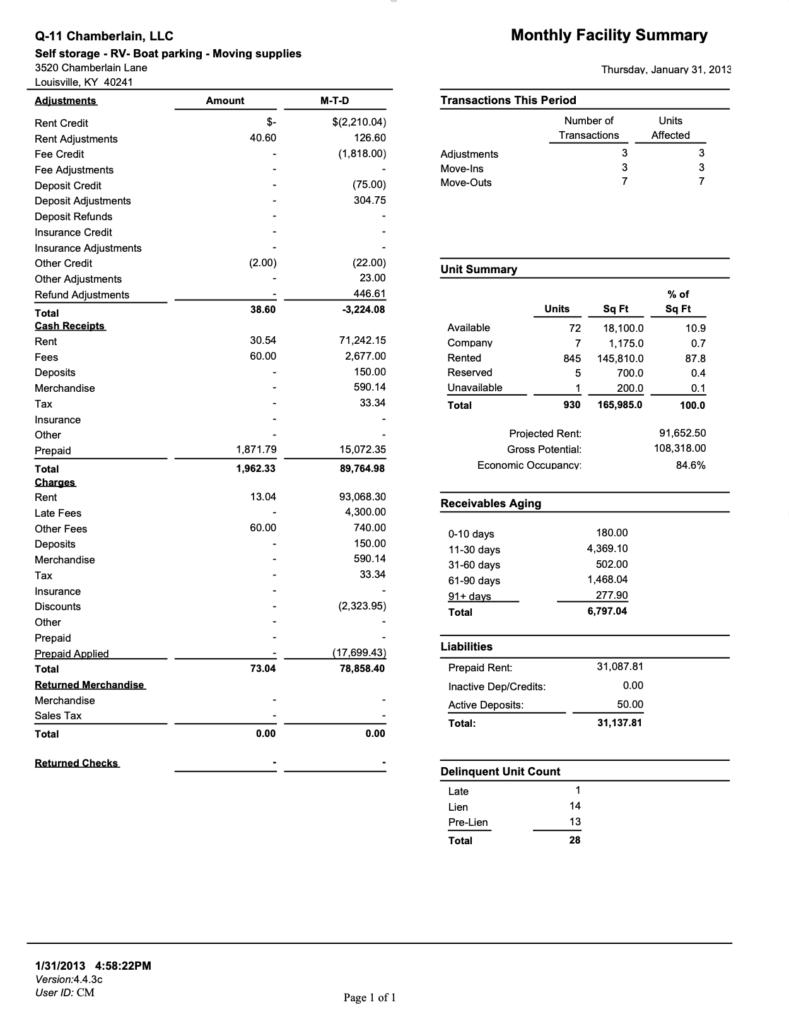
What was striking was their NOI was only about $425,000 the previous calendar year. As I looked at the potential numbers I saw the following:
GPI: $1,299,828
Econ. Occ. @88% $1,143,849
Op expenses at 40% $ 457,539
NOI Potential: $ 686,309
If my calculations were correct, at a 7% CAP rate, the potential value we could create was $1.6 million in a few months or so even without a price increase.
Just so you know, we created a lot more value than the $1.6 million over a few years, but let me share with you the four main steps we took and what we created.
Auction Delinquent Units
During the due diligence period we made a list of all units that were scheduled for auction the day we closed. There were only about 12 to 15 of those units.
Our general practice at the time was to allow the current manager to retain her job, but on a 60-day trial basis. We instructed her to not take anything less than 50% of what the past-due amount was from these units. If they paid 50%, they could empty their units and we would void their leases. If they could not, we were going to auction.
If I remember correctly, about three paid the 50%; the rest went to auction. Our occupancy dropped about 3%, but we now had units to rent up and start getting income on, and we could really see how the market would respond.
Designed a Capital Improvement Strategy
During the due diligence period, we also designed a capital improvement strategy. This involved fixing some metal roofs, painting the building, painting or replacing some doors, blacktopping, and generally making the project look more appealing.
We also upgraded the landscaping. Nothing too elaborate. We wanted to soften the project up, be more appealing to women.
In addition, we upgraded the camera system and added flat screens in the remodeled office showing all the camera shots behind the manager’s desk, so everyone entering the office would see. This goes a long way to making people feel their goods would be safe in our projects.
We spent only around $65,000 on the total upgrades.
Added Other Income Sources
As we were doing the upgrades, we also added other income sources.
The first thing we did was get rid of the one truck the previous owner had. He had purchased a truck and branded it with their logo. He allowed people to use it to move into the facility. Nothing wrong with this, it just isn’t what we do.
I sold the truck and those funds helped pay for the upgrade program.
We replaced the one “free” truck with U-Hauls. Our first year we added over $28,000 in U-Haul commission income to our NOI. When we sold the project 7 years later, we were earning over $60,000 in U-Haul income. Better than a “free” truck in my opinion.
Next, as we remodeled the office, we put up slat board and stocked it with retail items for sale.
In our first year of selling retail, we added over $10,800 in gross revenue at about a 50% profit margin. By the last year of ownership, we had $12,338 of retail sales.
Later in the ownership we also made tenant insurance mandatory, adding over $20,000 per year.
Price Increase
We continually made sure we were implementing rental price increases. Within the first four months, immediately following our capital improvements, we started. We averaged over a 5% per year price increase during our ownership.
When we sold the property, we had over $1.3 million in revenue from the property per year. That is a 51.09% increase from when we purchased it. The source of that increase was the rent increases and the additional revenue sources.
We increased the NOI over the ownership by close to $325,000. Also, CAP rates went down during the time of ownership and when we started getting unsolicited offers in the 5.5% CAP range, we decided to sell.
We sold the property for over 48% more than we purchased it for.
This was done in seven years with no expansion.
Conclusion
There was nothing extraordinary in the four steps we implemented.
Now this was perhaps one of the better projects we were involved with due to the large size. We purchased for $6.5 million and sold for $13.5 million in seven years, all without adding 1 new sq. ft. of income-producing space.
It takes a game plan, patience, and focus to implement a strategy, time, and perhaps some grace from the universe to achieve results like this. But nothing we did was extraordinary.
This is one of the reasons I love the self-storage business. A simple strategy from a simple kind of person like myself can create results like this sometimes.
Keep going
Start with Mark's free 3-part video series
How Mark approaches finding, analyzing and getting into self storage, in three short videos.
Listen
Creating Wealth Through Self Storage
New episodes every week with Mark Helm.
Learn with Mark live
The Inner Circle
Weekly live calls with Mark, a replay archive and a community of people doing the same work.
See the Inner Circle →More on Operations & Management
From the Knowledge Base
See all of Mark's free tools and education →
General education about the self-storage business, not investment, financial, tax or legal advice. Disclaimer
