A few weeks ago, we had a three-part series on Revenue Strategies designed for 2026. Now let’s focus on the expense side today.
In reality, we are really focused on the Net Operating Income (NOI) (income minus operating expenses before debt and reserves).
I am not going to go over every line item in this episode, rather, just a few I think can be impacted and a few general ideas and practices I might recommend to do that. In a separate episode, we will focus specifically on insurance and some ways to possibly reduce that expense item.
Tenant Retention
We don’t usually talk about this much when talking about expenses, but I learned a long time ago, if you are managing a real estate asset, you are in the tenant retention business.
I really understood this in the office management business. Every time a tenant moved out, we would have to spend from $20 to $50 psf to get a new tenant in there. Thankfully, in self-storage that is not the case, but in 2026 we definitely have costs we didn’t have ten years ago. I am thinking about the marketing expense. More on this in a minute.
But if you can keep a tenant longer, it definitely has a positive effect on your NOI line. In my experience, that is usually a function of customer service.
We talked about customer service in the three-part series on Revenue Strategies designed for 2026. I suggest over the ownership of any facility, track the value of each lease signed and how long the average tenant stays. If both are increasing year over year, that will make a huge difference in improving the value of your project, not to mention the positive effect on the customer experience of interacting with your brand.
Payroll/Labor Cost
This is an area where we owners can make a lot of headway. As I have said before, in a perfect world, we want to have our customers interacting with managers and employees. I feel it improves customer service, which increases tenant retention and generates referrals. Referrals are the least expensive way to attract new customers, and again, improve the customer experience.
So when I say work on reducing this line item or put your attention here, I am not advocating wholesale firing of personnel.
What I am saying is that if the right people are hired, through strategic technology implementation along with good training and focus, you can double or triple employee productivity.
Here is what I mean by that. Fifteen years ago, our company averaged about $250,000 of gross income per full-time employee. I am not sure how I got started tracking this, but I did and continue to use this metric as a gauge for employee productivity.
When we started using kiosks, our employee productivity increased. In other words, we started seeing north of $350,000, pushing up to $400,000 of gross income per full-time employee.
Then we started focusing on peak times during the week and peak times during the month at each unique facility and moving staff around based on what we were seeing. We broke the $400,000 barrier.
It’s not that we don’t hire, train, pay people well… we just need less of them today.
Constantly work on this line item. Especially in 2026.
Energy
We really noticed our energy costs went down when we started using LED lights.
A really good time to dramatically impact energy cost is when you put a new project into service. We try to put extra cash in the underwriting to upgrade HVAC if what is there is not energy efficient, change light packages on buildings and in signs if they are not LED.
I could also go into solar and other green energy solutions, but this is not the episode for that. Depending on where and what we are putting into service, as well as the current tax incentives (which change administration by administration), solar is something we at least look at. Especially in new construction.
However, today with bonus depreciation, accelerated depreciation made possible through cost segregation reports, this line item really needs to get special attention from each storage owner in 2026.
What temperature are your temperature-controlled buildings set at? 70 degrees? Lower or raise that depending on the season. Are your lights on timers inside buildings? If you have a drive-in door to a building, will it close automatically after a certain amount of time?
There are all kinds of ways to reduce energy cost and it is our job, no one else’s, to keep an eye on this line item. At least that is what I created for myself as an owner.
Marketing
This is the line item that I struggle with the most next to insurance cost.
We are constantly tweaking, adjusting, and working on better and more effective ways to show up online within each trade area in as cost-effective a way as possible.
I hear owners just throw up their hands and say, “There is no way I can compete with the REITs online today.”
If that is you, I hope you own projects in my trade areas.
For us as owners, this attitude is not an option.
I don’t want to use this episode to explain what we do in this area, and what I do today is different than what I was doing six months ago. It changes almost daily. Well, maybe not daily, but often. You get the picture.
The days of just turning marketing over to a vendor are over. Even if you have a vendor, or employee managing the online marketing, it is your job as an owner to measure, track, and know your metrics and how your marketing is performing. With Google Analytics, it is easy to see how you compare to your competition, trade area by trade area.
Constantly be working to keep this cost down and again, tenant retention goes a long way.
Also, I have learned the hard way, that if I am giving the farm away in early lease-up (like two or three months free rent), I get a lower-quality tenant whose average stay is shorter and who moves out often when the freebie is up. There can also be other problems associated with a lower-quality tenant over and above the revenue issues.
I am not saying in certain cases it is not appropriate to offer aggressive incentives, but just do so with eyes wide open. And remember, every problem you have today was the solution to another problem you had earlier.
Toward the middle of this year, I plan on doing an online marketing series of episodes.
What I have discovered today is this line item is a critical expense and one that must be there. Often, I see people underestimating the amount needed here, especially in lease-up situations.
However, I have also seen that this line item can get out of control very quickly if the owner is not on top of it. I don’t think anyone has made more mistakes in this part of ownership than I have over the years. I am still a work in progress here, but I really have my eye on this line item in 2026.
Property Taxes
For us, standard procedure is with every property tax assessment we receive, a tax consultant firm is chosen to analyze and see if they feel a successful appeal is possible.
You may be able to do this yourself, especially if you own and operate in one market or if you live there. But for me, I just always turn this over to a specialist.
The type of companies I use will make their money through fees, which are usually 50% or so of the first year’s reduction in property taxes I will receive as a result of their success. So they are not going to waste their time on my projects unless they feel they can be successful.
I would have some procedure in place to always determine if any property tax increase can be appealed. We have saved many tens of thousands of dollars over the years.
Insurance
This gives me the most heartburn today of any operating expense. Next week I will have a separate episode on this line item alone.
As storage owners it is critical to understand that climate change is generating more severe weather-related events and no matter where you are in the country, insurance costs have been going up exponentially.
We will discuss ways to reduce the increase we are going to experience in this line item next week.
2025 NOI’s
Here is why I am doing this episode. Look at the REITs’ NOIs for 2024 and 2025 below:
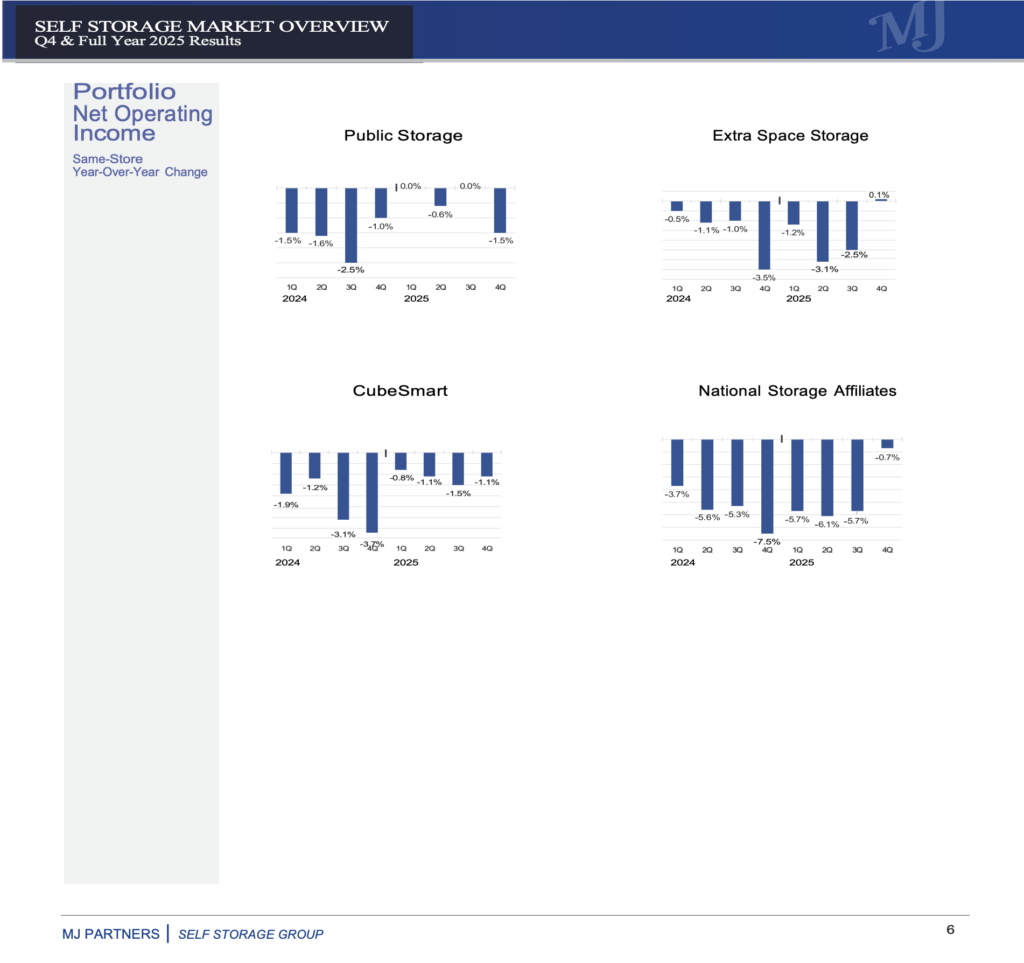
You can see the REITs’ NOI line was down across the board in 2025. Was your NOI up or down last year?
We need to really focus on this in 2026 and it is not a mystery how. It is just unexciting and tedious work that needs to happen. Nothing glamorous about it, but it requires our attention. And my coaching is: make it your job, not your partners’ and not the manager’s or a vendor’s job.
But you can make it fun. Create a game to see how much value you can create in 2026 by focusing on your operating expenses. I would love to hear your ideas and successes you have had in this area.