
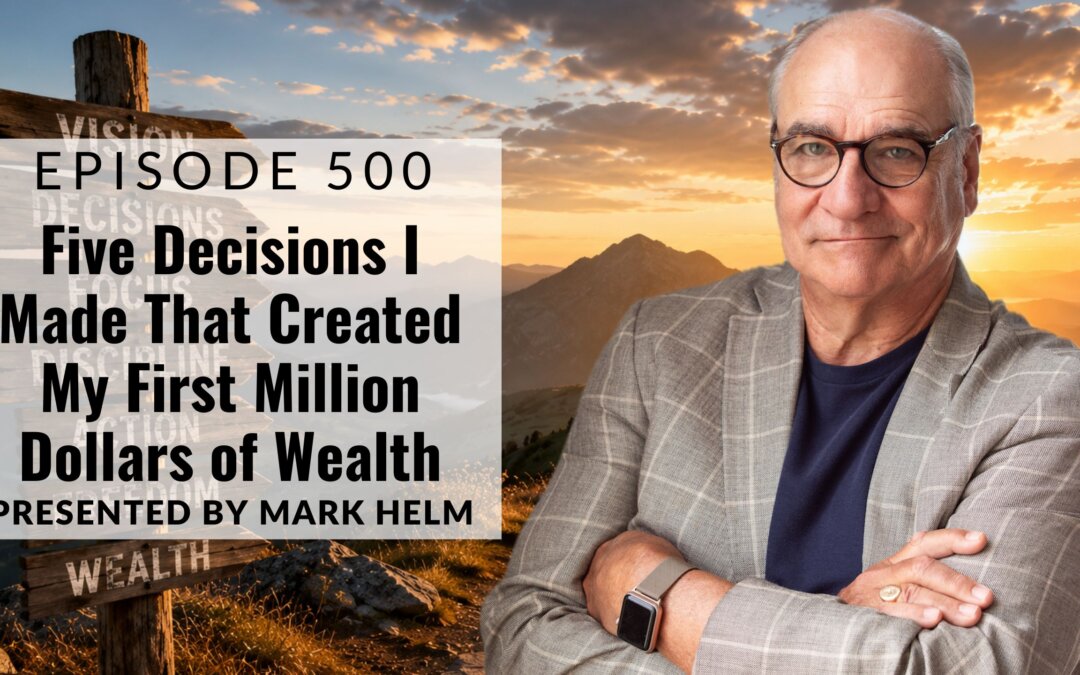
Listen to this episode

Here I am at Episode 500. It has taken me about 550 weeks to get to this episode, but nonetheless we are here. On one level, it means nothing really, but on another, it shows I can stick to something for a long time and/or you can hang in there with me no matter how bad or off I can be at times.
I hope you have received some value with these episodes.
Get the Practical Guide to Building Wealth in the Self-Storage Industry eBook.
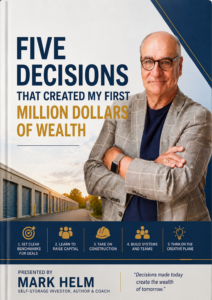
Last week I discussed some of my flaws and how they translated into some of my biggest mistakes I have made in my self-storage career. Today I want to talk about some of the things I did right. I chose to do this in the context of the decisions I have made that generated the first million dollars of wealth from the storage industry.
Interestingly enough, just like last week, very few, if any, of these decisions had much to do with the industry itself. They were decisions that, for the most part, changed the direction of what I put my attention on.
So here goes, the five decisions I made that generated my first million of wealth from this business.
1. Setting Clear Benchmarks For Deals We Would Consider.
I have said this often: my business took off once I got clear on my benchmark returns I needed to close on a deal.
What those benchmark numbers are specifically can change due to the economic environment, but I create them before looking at deals. For example, today, a minimum return an investor or partner may demand in a self-storage deal is, let’s say, 8%. Fifteen years ago, I used 12%.
But I always had a number before I looked at a deal.
What the benchmarks are specifically may be different for different people. For me, for example, given I was raising money from passive investors, I had a cash-on-cash benchmark yearly (or after a value-add play was completed), I had an IRR number (return on their investment over a certain time period, which was the life of the investment), and an equity amount that needed to be created from a value-add play (the amount of the equity I raised as a minimum).
I would underwrite the deals, and the deals would either reasonably appear to work or not work. If they didn’t, is it reasonable I could buy the property at a price that would work for me given the benchmark numbers I had? If it was a no, I moved on. If it was a yes, I dug in until I either (1) found out why I was wrong or (2) controlled the property through an LOI or contract and then did my due diligence.
As much as possible, I tried not to (1) get emotionally attached to a deal, and (2) put myself in a position where I had to close even if the deal didn’t hit my benchmark numbers after replacing my assumptions with real numbers from the due diligence (one of the reasons I chose never to do a fund model).
For the most part, I was able to stick with this rule, although I discussed last week one deal I didn’t.
Those were just my benchmark numbers. Yours may be very different depending on where you are in your career and how you are organized. Some people are more concerned with a monthly net cash number. Some are focused on paying debt down or off before retirement. Some people focus on equity that can be created and how fast they can sell or refinance to get that equity.
There is no right or wrong benchmark to focus on. Just create them before you start looking at deals.
A formula for failure is to be looking for a “good deal.” Why? Because that is a moving target that generates emotionally based analysis and creates more opportunity for failure, or at the least, a hodgepodge of different types of deals.
This decision helped us be and appear disciplined in our acquisition approach.
2. Learning To Raise Capital.
I quickly saw early in my career that if I only did deals myself with my own money, it was going to be a long, slow journey. I immediately saw the need to learn how to raise money from others. Yes, I had less ownership and had partners and investors, but that was “leverage” in my mind and allowed me to (1) grow faster and (2) spread risk over more locations and facilities.
So the decision I made was twofold: (1) to learn how to present storage opportunities in a way that solved a problem a potential partner or investor had and (2) find partners who could expose me to people with money to invest.
You may already know high-net-worth individuals, but I really didn’t. So I approached potential partners who could help me run the storage business, be sponsors with me (again, I had to give up a piece of the pie), and introduce me to their sphere of influence. I also had to learn how to research each person before I presented a potential deal and ask the right questions as I met them to learn what they were looking for in a deal (more specifically, what problem they were trying to solve).
Once I began to develop the skill of getting into someone else’s world and focusing less on me and the deal, I could tell if my opportunity really solved a problem they had. If it did, I would show them how. If it didn’t, I would tell them that.
Most of the people I presented to in my first ten years of real growth were people who had either started a business or inherited a business, then sold it to a national company. They had a lot of money to invest. The problem these people had was (1) they didn’t want to lose the money and (2) they wanted better than the “market” (i.e., better than, let’s say, a mutual index fund or the S&P 500 and/or the Dow Jones Industrial Average).
What is better than self-storage for that?
Once they really got what self-storage is and that, for the most part, the real risk is during the value-add play and/or lease-up, a high percentage of them were willing to invest in the deals. Once a couple did, the rest of their sphere often did so they would not “miss out.”
The disciplined acquisition approach I previously discussed helped.
It took time, but I was committed to developing this skill. It really paid off, and often I had more money than I needed for a deal and had to tell them they were first in line for the next one.
3. Taking On Construction.
Even to this day, my wife scratches her head when I discuss construction of self-storage. In her world, I am no contractor. She grew up in a household of electricians and tradespeople. I have a hard time putting up a towel bar in a bathroom that holds the weight of a wet towel.
But I learned that if I had to just buy existing storage and not be willing to do any construction, I was probably not going to be in the self-storage business. And if I had to always hire a GC (although I have done this on some deals), my cost in the projects was going to prohibit me from hitting my benchmark numbers.
I had to learn how to get partners and vendors, such as construction managers, that knew construction and could help me oversee expansions, conversions, and even ground-up developments.
I had a big fear around construction and had to take it on even though that fear was there.
Ultimately, as the industry has progressed, I found a great construction partner and helped him break into the business of self-storage construction and received a piece of his company. This has made it possible today to be able to handle a wider variety of projects and assist others in our community to be able to do the same. We focus on the small investor.
But I had to decide to start, beginning with expansions and conversions. I brought in partners who knew more than I did, hired strong construction managers, and made sure either my partner or I was on-site almost every day, learning what needed to happen and how to communicate and work effectively with subcontractors.
Fortunately, my ability to hammer or run equipment was not the skill set needed to oversee the construction. Sure, it helps, but I can hire or partner with people with that skill set. My biggest growth came from just being willing to take construction on even with the conversation in my head about it.
By doing this, we have created a lot of value and can take on storage projects that would have otherwise not made financial sense and turn them into great deals.
4. Building Systems and Teams.
Especially today, as the industry has evolved, no one person can have all the skill sets needed to run a successful storage business.
Sometimes after someone has attended the QuickStart Self-Storage Bootcamp, I see them struggling to get their first facility. Then they partner with someone, and what do you know…they are in.
A few weeks ago, I wrote an episode about how vendors can make or break you today.
Folks, we need a team today. Your partners, your vendors, your employees are all critical.
When I decided to grow my business, I made a lot of right decisions as well as not-so-right ones about team members and vendors. But I realized I needed to be part of a team. If I was going to get anywhere near my goals, I had to be part of a team that was all headed in the same direction.
Even the partners who joined as passive investors were bought into the goal and vision we created for our business and invested so they could be part of it. Many investors were not just investing in a deal; they were investing in the vision and wanted to be part of that growth.
The decision I made to be part of a team forwarded me into hyperspace headed towards my storage growth. I also created a vision that inspired me as well as the team. At that stage of my career, it was a $60 million self-storage portfolio. I knew if that was achieved, it could soon be worth over $100 million.
Next, I made sure all my partners, investors, key employees, and anyone who would listen were enrolled in that vision.
Then, as we grew, I realized we needed systems in place so the actual business ran over the systems rather than just the personality of the managers, the owners, or myself. For me, this was not as easy as getting people excited about my vision.
It is something I am currently doing again in my new storage teams and adventures today. This time, however, the industry is evolving at a very rapid clip, and we now have to stay on top of the changes as best we can on a day-by-day basis. The systems, structures, and vendors are changing more frequently, and the team members need to be flexible enough to change with the evolving landscape.
However, it was the decision to be part of a team rather than a solopreneur that made the difference in my storage growth trajectory and forwarded me towards the first million.
5. Thinking On The Creative Plane Rather Than The Competitive Plane.
Well…I wrote an entire book on this, but when I made the decision to focus on this, my life altered.
The Second Principle of Wealth Creation in the book is:
… one must pass from the competitive plane of thinking, where resources are limited, to the creative plane of thinking, where there is infinite supply.
The Second Principle of Wealth Creation
In essence, I mean shifting from a mindset of scarcity to one of infinite possibility.
This shift is everything.
Scarcity beliefs sound like:
- For me to gain, someone else must lose.
- There are only a limited number of storage opportunities left today.
- It’s hard to get in the business.
- Money is hard to get.
You know the thoughts. These thoughts, while common, are toxic.
When I made the decision to shift from a scarcity mindset to an abundance mindset, what it did was force me to focus on my goals and visions, not the minutia of how it was going to happen.
Yes, I formed plans and strategies, but every day I focused on my vision and then got dressed and went to work and did the next thing in front of me.
It is some of the hardest focus of attention one can have, on what is possible, not on the problems in the way.
I discovered that when I created the vision of the $60 million portfolio, for example, what was in my face was “not that.” The world I woke up into was anything but the $60 million portfolio. However, over time I developed the muscle of keeping my attention on the vision, regardless of what was currently present and I had to deal with. That is a skill set that can be developed, but it takes a decision. And my first million happened after that decision was made that this is who I am.
In fact, of all the decisions I have made, this one is the hardest work of all. To keep the vision present while the appearances in front of me are “not that.” Once one can develop this skill, the world of true possibility opens up.
At least that was my experience and the experience of many I have worked with.
Conclusion
These were the five decisions I made that created my first million in wealth from self-storage. I share these with you in Episode 500, hoping they could inspire you to make some decisions for yourself.
Nothing I said here guarantees anything. As you know, you and you alone are responsible for your own success in the business and in life. I don’t even think these should be your decisions necessarily. They were just mine.
I hope this may inspire you to create a vision worthy of the next few years or the next decade of your life and then make the decisions that are necessary for you to fulfill on it.
It’s definitely a journey worth taking.
Keep going
Start with Mark's free 3-part video series
How Mark approaches finding, analyzing and getting into self storage, in three short videos.
Listen
Creating Wealth Through Self Storage
New episodes every week with Mark Helm.
Learn with Mark live
The Inner Circle
Weekly live calls with Mark, a replay archive and a community of people doing the same work.
See the Inner Circle →See all of Mark's free tools and education →
General education about the self-storage business, not investment, financial, tax or legal advice. Disclaimer
