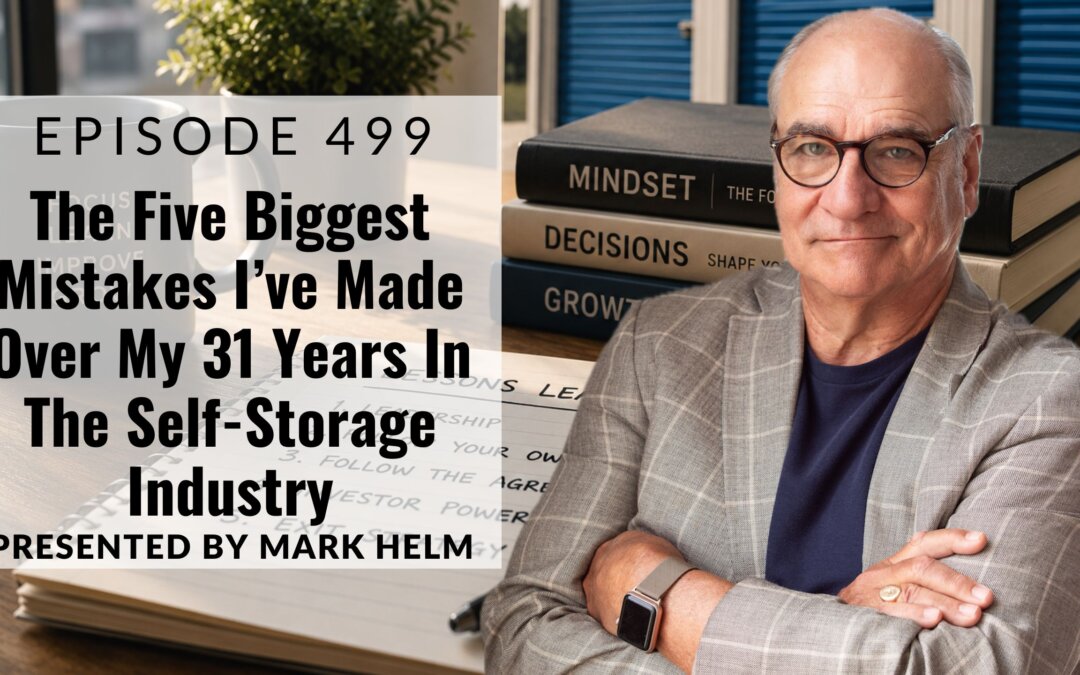
As I approach Episode 500, I have been thinking a lot about the self-storage business and my thirty-one years in and around the business.
I was thinking about what I could share that would be helpful. I had two startling insights. The first was that what would be most helpful is not what I’ve done right, but more importantly, the biggest mistakes I have made.
The second was, as I wrote them out, the realization that none of my biggest mistakes were about the business itself necessarily or making a bad storage decision, although I’ve made my share. They were personal development flaws in myself that had an impact on my business.
That reinforces my concept that if you want to grow and expand, work on yourself first, then tackle the business. Expand who you are so you can expand your business.
So, with that said, let me share with you the five biggest mistakes I have made over my thirty-one years in the self-storage business.
Mistake Number One – Leadership, Partner Selection and Management.
Let me be clear here, I am grateful for all the partners I have had over the years, and there have been a lot. I realize now that often, we tend to consciously, or unconsciously, seek partners to fill weaknesses we perceive in ourselves.
One of my weaknesses is the tendency to avoid conflict. A lot of reasons for this, but it, like most people’s weaknesses, had its roots in my family of origin issues.
So often, I tend to surround myself with strong-willed people who will take on some of the harder tasks I tend to avoid, especially if I am unaware of my weaknesses as I was earlier in my career.
This may sound like a good thing, but it also can cause problems. There were times when I, as the organizer of these partnerships, as I was through the first twenty-five years or so, needed to address decisions partners were making that had a negative effect on the business and investor relationships, and I did not do so.
Without strong guidance from me, which was my job, problems could build up. Then there was a real issue to solve, and that is when I would finally step in. One example would be partners hiring people who I knew were not up to the task, but rather than address it then, I would wait until they failed or there was a problem, then insist on letting them go. There are many other examples, but I don’t feel it is appropriate here to go into them.
The takeaway is I had to work on myself, getting training outside of the storage industry, to become a better leader. I sure wish I had done this from the start. We would have achieved the vision we created a lot faster if I had.
Mistake Number Two – Not Following My Own Advice.
I teach people to never get too emotionally tied to a storage project. We need to be able to walk if, during the due diligence period, we discover the deal won’t meet our predetermined financial benchmarks.
I have had one deal that went south and did not work out at all how we planned, and it was because I, as the organizer, did not follow my own advice. I got really excited about the deal because I could get in without having to buy land. The owner was contributing land and becoming a partner.
The deal was at the end of a cul-de-sac in a business park, next to an expressway, and during the due diligence, I failed to recognize the sign ordinances had changed, not allowing a sign to be seen from the expressway. I thought that would solve my visibility issues.
Also, household income was on the lower half of the city, but again I figured I could “market” my way to success.
I would totally advise someone else not to think that way.
Long story short, lease-up took way longer than I projected, and I realized we had to pivot or have real issues. I proposed a capital call to create more parking, which was creating income, and wait until other competitors finished their lease-up. Some of my partners refused.
I exchanged free and clear land for their equity, which they asked for rather than stay in the deal.
We did the pivot, then sold the property as a “must take” with another very successful storage project and made a profit.
This is the only deal I have done in which some of the partners did not make a profit from the storage project, the ones who took the free and clear land. I hope they made a profit from the land.
People tell me not to feel bad because they chose not to stay in the deal, but perhaps this would not have happened if I had followed my own advice. Hindsight is always 20/20.
Mistake Number Three – Not Following the LLC Agreement to the Letter.
Again, weak partnership management on my part plus letting the operating agreement become a document we signed and shelved instead of the rulebook we actually ran the business by.
A partner made a decision, although a well-intentioned one, to release a vendor and hire a spouse to do a job for less money. However, our LLC agreement spelled out the compensation that sponsors and their families could receive, and this job was not one of them.
One of my investors knew the document better than I did and got upset when they realized we were paying a sponsor a fee outside the scope of the agreement. This mistake on my part took a long time to rectify and caused this particular investor to double- and triple-check everything we were doing. Investor trust is absolutely critical, and when tough decisions need to be made, if the trust is not 100% there, problems can arise.
I learned this the hard way in this instance. It has stuck with me ever since.
Mistake Number Four – Giving Investors Too Much Power.
In an effort to be “investor friendly,” in the early days I would give in to a lot of investor requests that I wish I hadn’t.
Perhaps the biggest one was in a syndication where I had raised funds to purchase about three or four facilities, and the investors wanted a board. The board was initially to approve the acquisitions but later morphed into an oversight board.
I spent a lot of time creating useless reports, totally useless financial models, justifying selected vendors and having to entertain their recommendations, and so forth. This was before AI, so I was the one in the partnership who had to create and then populate all these reports.
It took valuable time away from real income-producing activity, and I swore I would never allow this type of thing to happen again. I haven’t.
Mistake Number Five – Weak Pre-Planned Exit Strategy for My Sales Proceeds.
I have sold a number of projects, and in some of the deals I had to pay large capital gains due to how the LLCs were structured.
However, in a couple of the deals I was in, I was able to 1031 the sales proceeds or move them into good opportunity zones, but not always.
I have made some hasty decisions to avoid capital gains that I wish I had not made a couple of times. The one that stands out was one I did a few years ago. We had a closing in mid-December, and if I invested the proceeds into an opportunity zone by the end of the year, I could further reduce my tax basis another 10%. It was going into a storage project we could build and I could run and manage. It was tight but appeared to work.
Within six months, interest rates started rising and more products came on in that market, and the deal no longer worked. Long story short, the land is still sitting there and nothing is on it. I have over $300,000 tied up for a few years generating nothing. I sure wish I had just paid the tax and put the money to work. I would be ahead of the game. Again, hindsight is 20/20.
Notice all, or almost all, my mistakes were mistakes in my thinking, not making a wrong business decision?
I have learned that if I am going to expand my business, the first thing I do is work on me, expand who I am, so that I am personally a better version of myself and have expanded enough to be the right person for the expanded business.
That is perhaps my biggest takeaway in the last thirty-one years.
(A shameless plug – My new book The Creative Method of Wealth Generation goes into depth on how we can use our mind to create the wealth and life we want.)