
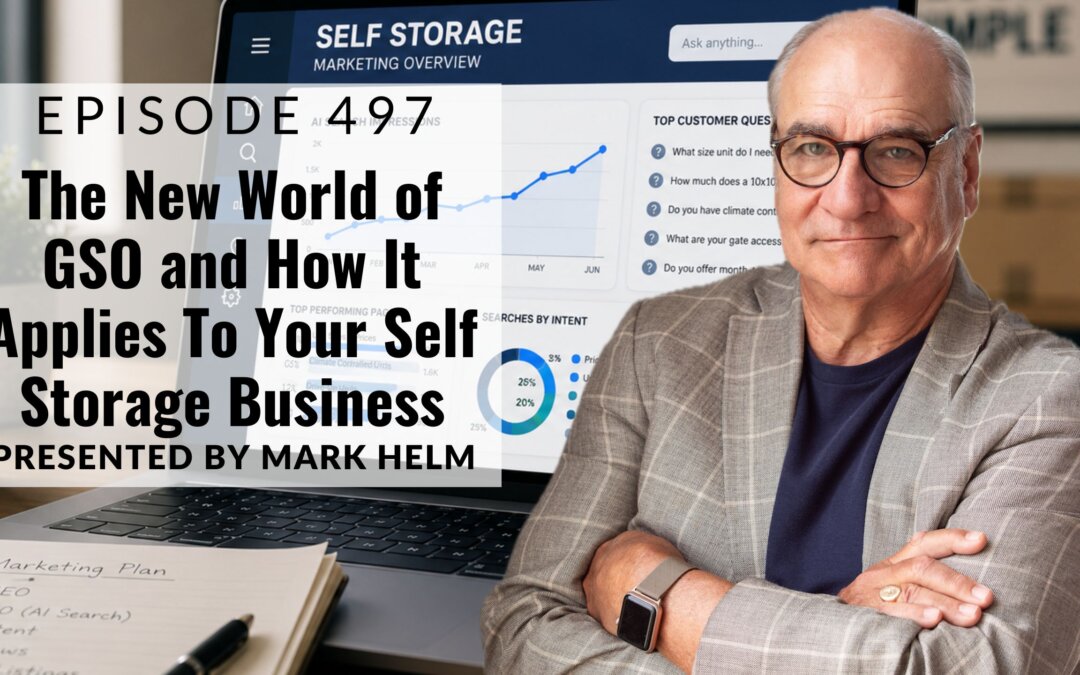
Listen to this episode


Although you may be tired of hearing about AI and how it applies to your self-storage business, the AI hole is only getting deeper. If you haven’t already, it’s now time to embrace it and begin to understand how it is currently affecting your marketing, operations, and ability to get online customers.
You have heard of SEO, Google algorithms and their effect on your business, pay per click, and the gamut of online marketing terms. There is a new but vitally critical term you have got to understand today…the new world of GSO.
GSO stands for Generative Search Optimization (sometimes called Generative Engine Optimization, or GEO). It’s the practice of optimizing your website content so it gets surfaced, cited, and recommended by AI-powered search and answer engines like ChatGPT, Claude, Google’s AI Overviews, Perplexity, and Gemini.
Now, this doesn’t replace traditional online activities you are doing; it is in addition to them.
From what I can tell, here’s how it differs from traditional SEO and why it matters for self-storage operators:
Traditional SEO vs. GSO
SEO optimizes your website for ranking in a list of links. GSO optimizes for being the answer the AI gives. When someone asks ChatGPT “what’s the cheapest 10×10 storage unit near Tampa?” or “which storage facility in Austin has climate control and 24/7 access?”, the AI synthesizes an answer from sources it trusts. GSO is about making sure your facility is in that trusted source and quoted, named, and linked.
Why this matters for self-storage specifically
Self-storage is a specific-need, hyper-local, comparison-driven purchase. Customers can ask very specific questions: unit sizes, pricing, climate control, drive-up access, 24-hour gate access, RV/boat parking, month-to-month terms, insurance requirements, hours, gate codes, or even very general questions like what is the best or nearest facility to me. These are exactly the kinds of factual questions AI loves to answer directly, meaning the searcher may never click through to a website at all. If your facility isn’t represented in the AI answers, you’re invisible and irrelevant at the moment of decision.
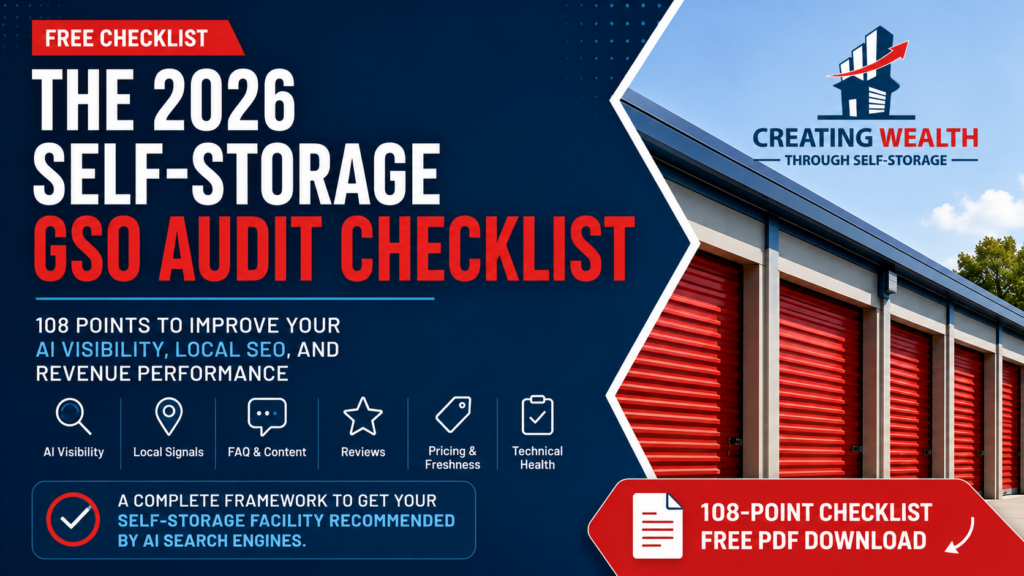
Click here to download the checklist,
How to apply GSO to a self-storage website
Structure content as direct answers to real customer questions. First of all, know the real customer questions and keep up with them. Next, have a robust FAQ that answers questions like “what size unit do I need for a 2-bedroom apartment?”, “do you require insurance?”, “what’s the difference between climate-controlled and standard units?”, or “can I access my unit at night?”. Write in clear, declarative sentences. AI extracts well-formed factual statements better than glossy marketing speak such as “best” or “great customer service.”
AI engines need to cite you confidently: exact address, hours, gate access hours, every unit size you offer with current pricing, amenities (climate control, drive-up, elevator, RV/boat parking, electricity, security cameras, gated access), accepted payment methods, lease terms, and any move-in specials. Vague pages (“competitive pricing, great service”) get skipped; pages with concrete facts get cited.
Also, build third-party authority. This means AI engines put a lot of weight on your facility mentions across the open web. That means accurate listings on Google Business Profile, Yelp, SpareFoot, StorageCafe, Apartments.com-adjacent directories, local chamber sites, and a steady flow of genuine Google reviews. When an AI is deciding which Tampa facility to recommend, it’s pattern-matching across dozens of sources, not just your homepage.
Create location-specific pages with substantive local content like neighborhoods served, driving directions from major landmarks, and what kinds of customers you serve (students near a university, boat owners near a marina, contractors near a job corridor). Thin “city + storage” pages don’t work anymore; depth does.
Keep pricing and availability up to date. AI tools increasingly favor sources that look authoritative and current. Stale pricing pages from 2023 get filtered out.
Periodically ask ChatGPT, Perplexity, and Google AI Overviews questions a real customer would ask in your market (“best self-storage in your city”, “climate-controlled storage near your neighborhood”) and see whether you appear and how you’re described. If a competitor is being recommended and you’re not, that’s a content and authority issue, and a gap to close.
The customer marketing angle
Beyond your website, GSO shapes how you should think about all online content: blog posts answering moving and storage questions, YouTube videos about packing and unit organization, guest posts on local moving company blogs, and partnerships with realtors and apartment communities. Every piece of content is a potential citation source for an AI answering, “where should I store my stuff during my move in Pensacola?”
The short version: traditional SEO got you found. GSO gets you recommended.
Welcome to the brave new world of GSO. If you are interested, there is a free GSO audit checklist I have put together that you can use. {please create landing page and link to Keap…thx}.
Keep going
Start with Mark's free 3-part video series
How Mark approaches finding, analyzing and getting into self storage, in three short videos.
Listen
Creating Wealth Through Self Storage
New episodes every week with Mark Helm.
Learn with Mark live
The Inner Circle
Weekly live calls with Mark, a replay archive and a community of people doing the same work.
See the Inner Circle →More on Marketing & Customers
From the Knowledge Base
See all of Mark's free tools and education →
General education about the self-storage business, not investment, financial, tax or legal advice. Disclaimer
