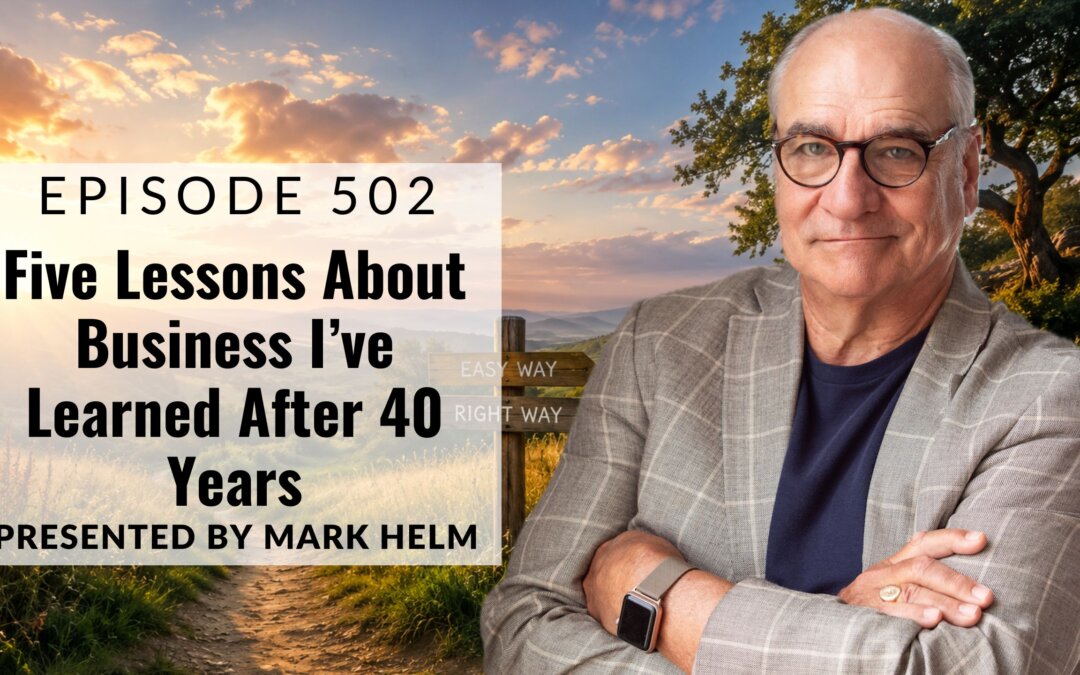
After over forty years in real estate and the self-storage business, I have learned a few things about business that I am sharing as I hover around this 500-episode mark.
I guess we could call these episodes “What I’ve Learned About Wealth, Business, and Life.” This also coincides with my newly released book, The Creative Method of Wealth Generation.
Let me share with you five things I have learned about business over the years. When I started, I knew very little about money, wealth, and running businesses. I have learned what I know through research and grinding away.
Much of what I will share will be excerpts from the book, and I will identify them.
1. Your economic value is a function of the problems you can solve.
This is straight out of Chapter 13 of The Creative Method of Wealth Generation:
A person’s economic value in the marketplace today is determined by one thing—the value of the problems they can solve for other people.
This may sound a bit bold, but look around. I think you will see it is true. All people are equal in worth and dignity as human beings. But in the marketplace, value is measured differently. It’s not about intrinsic worth; it’s about what the market will pay for problems you can solve and who you are solving them for.
Take, for example, a fast-food worker and a hedge fund manager. Both serve society. Both are needed. But the marketplace rewards them very differently. The restaurant worker solves the problem of providing inexpensive food to hungry people. It doesn’t require advanced skill, but it’s valuable and necessary work. However, the marketplace does not place a very high economic value on their contribution and the problem they solve.
A hedge fund manager may have an income of millions of dollars per year plus a percentage of ownership in the fund they manage, which could also be worth millions or even billions.
They are solving a problem for high-net-worth individuals called “how to get higher returns on their money than the market.” The market is usually defined today as the Dow Jones Industrial Average, which is the performance of 30 large, publicly traded companies, and the S&P 500, which is the index of the largest 500 publicly traded companies in the US.
The marketplace today places a much higher economic value on solving the high-net-worth individuals’ return-on-capital problem than on solving the problem of providing fast, inexpensive hamburgers. You may or may not agree with this reality, but opinion doesn’t change how the marketplace works.
So, what’s the point?
- The amount of money you can earn is a function of the problems you can solve.
- You can create vast wealth by solving the right problems for the right people.
As I have learned in life, it is often the questions we ask ourselves that determine the quality of our life. One of the questions I always ask when I am contemplating a new company is, “What is the problem I am solving, and who is it for?”
For example, when I helped form our new self-storage construction company, I saw that smaller investors like myself were losing deals when we got the market’s current normal self-storage contractors to bid jobs. We were receiving bids in the $90 to $130 psf cost range. For most small investors, these numbers just make it cost-prohibitive to do most deals today. So our construction company was formed to solve that problem for the smaller investors.
If there is no compelling answer, or if the people or group you are solving the problem for can’t afford it, you are going to be challenged from the start.
It took me a long time to figure this out.
2. Do more than you are paid for.
This is out of Chapter 12 of the new book:
We operate from a mindset of mutual benefits.
For us to receive our good, we must help others receive theirs. People using the Creative Method of Wealth Generation are adding to, increasing, and expanding the flow of life.
This does not mean we overpay for products and services. It does not mean we don’t negotiate. However, we provide more than we are paid for. We will cover this in greater depth in a later chapter, but it is critical that you begin to embody it now.
Both Napoleon Hill and Wallace Wattles talk about this concept. Hill states in Think and Grow Rich, “The man who does more than he is paid for will soon be paid for more than he does.” Wattles says it this way in The Science of Getting Rich, “Give every man more in use value than you take from him in cash value; then you are adding to the life of the world by every business transaction.”
I read this in the mid-1980s as I was learning about business and how to create wealth. I took it to heart, and it has been a guiding principle and value I have attempted to use in my business life. For those of you who have worked with me in the past, I hope that was your experience of our time together.
It has served me well.
Have I left money on the table at times? I am sure I have. But the quality of the relationships and the doors that have opened up to me far outweigh any meager amount of money I may have been able to earn that I didn’t.
I am so grateful I read Think and Grow Rich as I started my real estate career.
3. Systems Beat Talent
At first, every business depends on the owner’s effort. But eventually, if the owner remains the system, growth stops, or at least growth is very slow.
I learned this the hard way as we started scaling up our self-storage business.
As we started growing, we focused on hiring great managers. However, even that can be a problem because our managers would take such ownership of the facilities, they each began to run them differently.
It was hard to move a manager from one facility to the next to cover and not have issues. As owners, it became harder for us to figure out what was happening, and we always had to have the manager involved. Finally, if a particular manager ever left the company, it took something to re-create what their real procedures were.
Finally, we’d had enough.
I saw that systems and structures were critical if we were ever going to have a storage company instead of a bunch of individual storage projects.
We began to create systems and procedures. If someone ever did something more than once, it was documented. Ultimately, we created systems for our storage business in the areas of:
- Operations
- Marketing
- Customer service
- Financial reporting
But remember, the storage industry, as well as almost all other industries, is evolving fast. These structures and systems need to be breathing, living documents that are constantly being updated and evolving to keep up.
Think about AI and marketing. What we do today is very different than what we did six months or a year ago.
I never realized how critical systems are to growing a business until I was up to my tail in alligators.
4. Cash Flow Solves Most Problems, or You Can’t Spend Profit…Only Cash
Now again, most people know this, but a P&L (i.e., profit and loss statement) is just that…it’s all about profits.
I would look at them and wonder where the money went. We were showing a profit, but often the money in the account didn’t match those P&Ls.
It took me a while to realize P&Ls were primarily what our CPA needs to file taxes. Taxes are based on profits.
I can’t spend profits!
I can only spend cash!
P&Ls don’t measure cash. They measure profits. I realized I had to figure out how to read balance sheets, P&Ls, and cash flow statements. Once I got this, a whole new world opened up for me. I could begin to see dials and levers to pull and turn as I looked at these reports. I wrote an entire series of episodes on this, Episodes 114 through 118. You can find them on my YouTube channel or at CreatingWealthThroughStorage.com.
Now again, many of you have been through accounting classes or taken business in college and know this, but I sure didn’t. I had to figure out how to read them on my own. Every business owner should, in my opinion.
5. The Right Partners Accelerate Success.
If you remember in last week’s episode, I talked about how wealth is brought to us through other people and that I think relationships are more important than capital.
Relationships are everything.
Especially when it comes to partners. Great partners can accelerate growth, help you grow professionally as well as personally, and can extend out beyond you in knowledge.
Teams determine if you grow, how fast you grow, if you are growing in the right direction, and if you are growing with integrity.
As I get older, I have learned to be very picky about who my partners and teams are. I spend way more time thinking through this now than I did earlier in my career. It’s not that I don’t make mistakes, but believe me…fewer of them now.
I think it is critical to have the right team and partners in business because no one person can handle all that needs to happen today to be successful. So approach partnering and forming teams with eyes open. It is impossible to have every person or company on every team be the perfect ones, but be willing to recognize when they are not, and change something as needed.
When I first got going in business, I recognized this fact as a concept, but I didn’t fully understand the implications, both good and bad, until I lived through it.
I hope these ideas help you on your journey as you grow your businesses, and I would love to hear your thinking on this.